
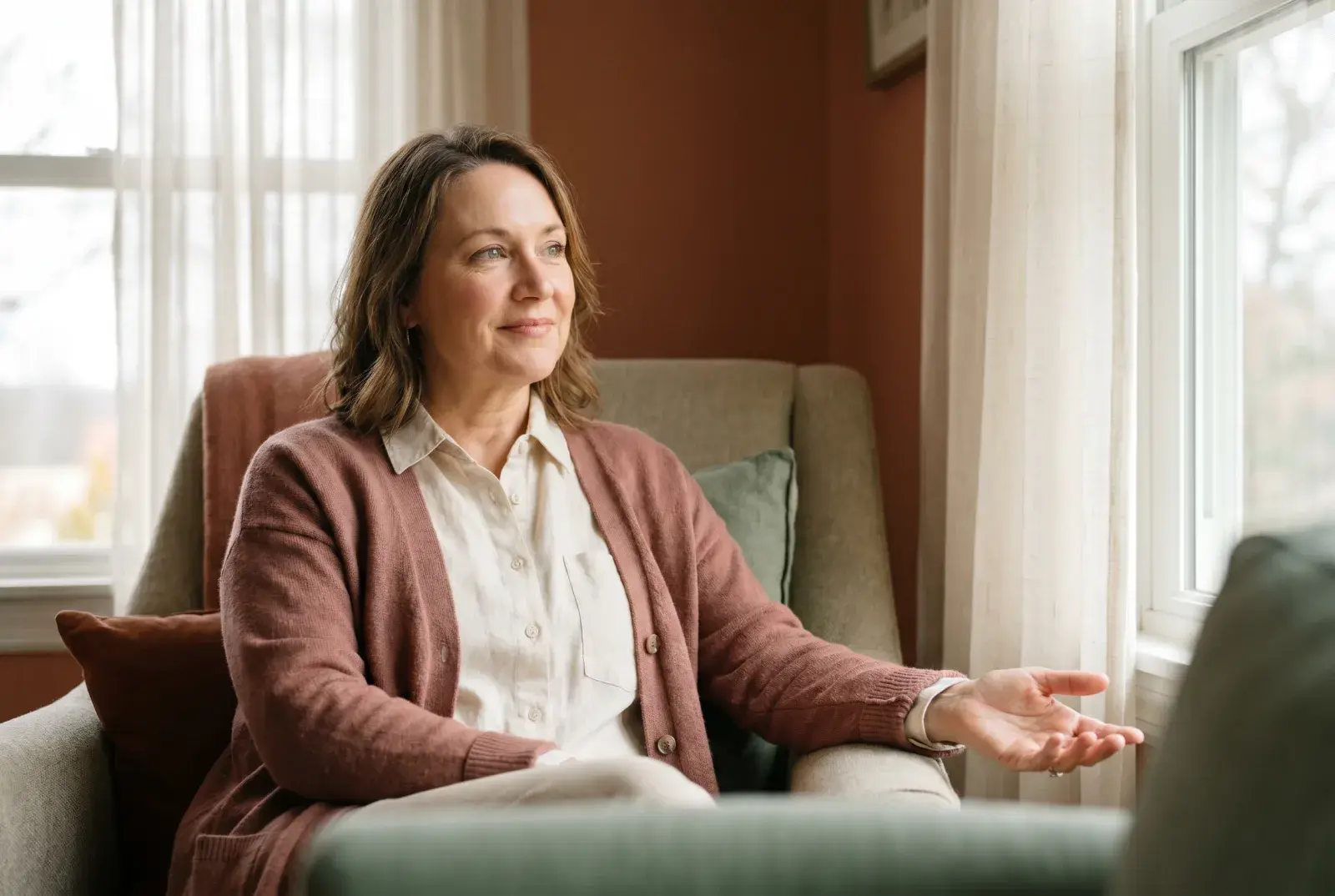
You can feel it happen in real time. Someone asks for something, and before you have even checked in with yourself, the yes is already out of your mouth. You smooth the conflict, anticipate the need, and rearrange your day around what everyone else wants, and only later, alone, do you notice the quiet resentment and the exhaustion underneath.
If you are a woman in midlife, people-pleasing is not a small personality quirk. It is often a decades-deep pattern, one you were rewarded for your whole life. The good news is that it is a habit, and habits can change. Learning how to stop people-pleasing is one of the most freeing shifts you can make in this chapter, and here is how to begin.
Why women become chronic people-pleasers
You did not become a people-pleaser by accident. Most women were taught it, explicitly and implicitly, from a young age. Be nice. Do not be difficult. Take care of everyone. Put yourself last. For decades, especially through the caregiving years, pleasing others was not just expected. It was survival, and often it was love.
So your nervous system learned that your safety and your worth depended on keeping everyone else happy. After twenty or thirty years of that, saying no can feel genuinely dangerous, even when nothing bad will actually happen. Understanding this matters, because it means your people-pleasing is not a character flaw. It is a deeply practiced pattern, and what is practiced can be re-practiced.
What people-pleasing actually costs you
The bill for a lifetime of pleasing comes due in midlife. People-pleasing keeps you depleted, because you are always pouring out and rarely refilling. It breeds quiet resentment, because part of you knows your needs never make the list. And, most painfully, it disconnects you from yourself, because when you spend years tuned to what everyone else wants, you slowly lose track of what you want.
That last cost is the heaviest. Many women reach midlife and realize they no longer know their own preferences, desires, or opinions, because they buried them long ago to keep the peace. Learning to stop people-pleasing is not only about boundaries. It is about finding your way back to yourself.
How to stop people-pleasing
This is a practice, not a switch you flip. Start small and be patient with yourself.
- Create a pause. The pattern runs on autopilot, so the first move is to slow it down. When someone asks something of you, practice saying, "Let me check and get back to you," instead of an automatic yes. That small pause gives you room to actually consult yourself.
- Ask what you want. In the pause, ask a question you may not have asked in years: what do I actually want here? At first you may not know. Keep asking. The answer gets clearer with practice.
- Start with low-stakes no's. You do not have to begin with the hardest relationships. Practice declining small things, the optional commitment, the favor you do not have time for, and let your nervous system learn that you can say no and survive.
- Expect the guilt, and do not obey it. When you choose yourself, guilt will show up, loud and convincing. It is not the truth. It is the old pattern protesting. Notice it, thank it, and choose yourself anyway.
- Let some people be disappointed. This is the hardest and most freeing part. You cannot keep everyone happy and also be honest. Disappointing someone is not a failure. It is sometimes the price of integrity.
- Refill as you go. People-pleasing emptied your cup. As you set boundaries, fill it back up. My piece on how to fill your own cup walks through exactly that.
Boundaries are an act of love, not a wall
Many women resist boundaries because they have been taught that boundaries are selfish or cold. They are not. A boundary is simply you being honest about your limits, and honesty is far kinder than a resentful yes that curdles later.
When you stop people-pleasing, your relationships do not fall apart. The healthy ones get more honest and more real, because the people in your life finally get the actual you instead of a performance of endless accommodation. The relationships that depended on you having no boundaries were never truly serving you anyway. Boundaries do not push love away. They make room for the real thing.
Coming home to your own yes
Underneath all of this is a deeper shift. For decades, you were the emotional anchor of everyone else's life, tuned entirely to their needs. Learning to stop people-pleasing is part of how you become the anchor of your own life, grounded in your own wants, your own no, and your own yes.
That is not selfishness. It is wholeness. And the woman who knows her own yes, and means it, has far more genuine love to give than the one who says yes to everything and slowly disappears.
Frequently asked questions
Why am I such a people-pleaser?
People-pleasing is usually a learned survival pattern, not a character flaw. Many women were taught from a young age that their worth and safety depended on keeping others happy, and decades of caregiving reinforced it. Because it is learned, it can be unlearned.
How do I start setting boundaries without feeling guilty?
Expect the guilt and recognize it as the old pattern protesting rather than the truth. Start with low-stakes no's, create a pause before answering requests, and choose yourself anyway. Over time the guilt quiets and boundaries feel more natural.
Will I lose relationships if I stop people-pleasing?
The healthy relationships usually get more honest and real, because people finally get the actual you. Relationships that depended on you having no boundaries were not truly serving you. Boundaries make room for genuine connection.
How do I know what I actually want?
Years of pleasing can dull your sense of your own desires. Begin by pausing before you answer and asking, "What do I actually want here?" even when you do not know at first. The answer grows clearer with practice.
Reclaim your own yes
- Download The Clarity Guide, my free first step for women learning to put themselves back on the list.
- Join The Oasis, a free community of women reclaiming their voice and their boundaries.
- When you want a structured path, explore The Divine Plan for a Life You Love or book a free discovery call.
Related reading: How to Fill Your Own Cup and How to Find Yourself Again.
Jenny Warner is a Certified Life Coach who works with women 45 to 60 navigating the midlife identity shift, integrating HeartMath research on heart coherence, somatic practice, and the divine-feminine lineage into a grounded path she calls the Frequency Anchor.