
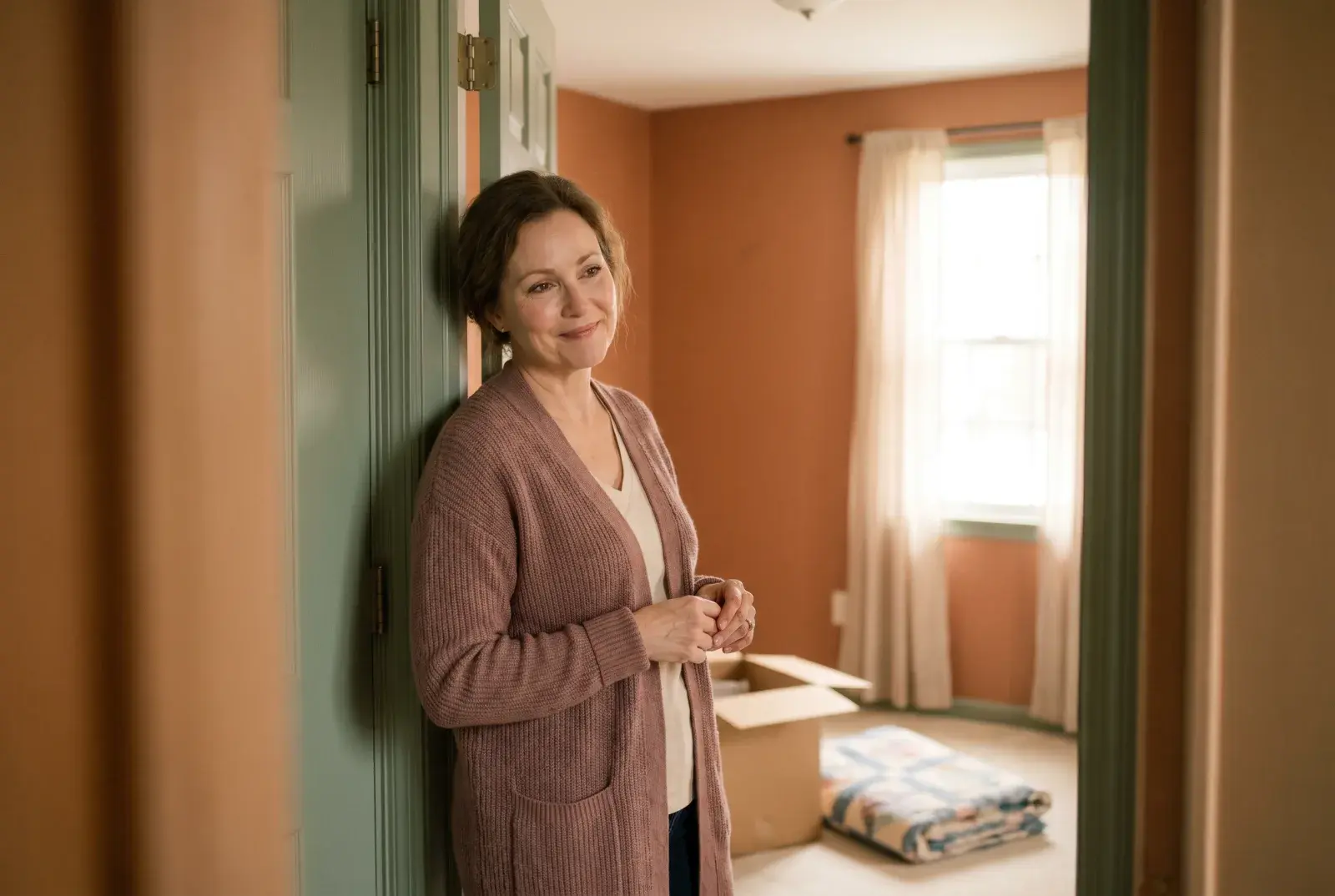
The house is quieter than you ever imagined it could be. There is a clean kitchen at 6 p.m., a phone that does not buzz the way it used to, and a feeling you cannot quite name that sits in your chest when you walk past a bedroom that is suddenly, permanently tidy.
If you are a woman somewhere between 45 and 60, and your children have recently left or are about to, you may be wondering why a milestone you spent eighteen years preparing for feels less like a graduation and more like a quiet kind of grief. There is a name for it. It is called empty nest syndrome, and you are not broken for feeling it.
This is not a clinical diagnosis, and it is not a character flaw. It is what happens when the role that organized your days, your identity, and your sense of purpose changes shape all at once. Let's talk about what empty nest syndrome actually is, why it lands so heavily on women in midlife, and how to move through it without abandoning yourself in the process.
What is empty nest syndrome, really?
Empty nest syndrome is the grief, loss of purpose, and identity disruption that many parents feel when their last child leaves home. It is not a disease. It is a transition, and like every meaningful transition, it asks something of you.
For decades, your attention had a center of gravity. Meals, schedules, worries, celebrations, and a thousand small acts of care all pointed in one direction. When that direction empties out, the question underneath the sadness is rarely "How do I fill the time?" It is something far more tender: Who am I now, when I am no longer the one everyone needs?
That question is not a problem to be solved quickly. It is an invitation, and we will come back to that. First, let's name what you may be feeling, because naming it is the beginning of relief.
The symptoms of empty nest syndrome
Empty nest syndrome shows up differently for everyone, but the most common symptoms cluster into three areas. You may recognize yourself in several of these at once.
Emotional symptoms
- A persistent sadness or tearfulness that surprises you
- A sense of loss of purpose or direction
- Loneliness, even when you are around other people
- Anxiety about your child, your marriage, or your future
- Guilt, as though you should be happy and "free" but feel the opposite
- Irritability or a short fuse you do not recognize in yourself
Physical symptoms
- Trouble sleeping, or wanting to sleep far more than usual
- Low energy and a heavy, depleted feeling
- Changes in appetite
- A restlessness you cannot settle
Relational symptoms
- Feeling distant from your partner, or noticing how much the children held the conversation
- Calling or texting your kids more than feels comfortable for either of you
- Withdrawing from friends, or feeling like no one quite understands
A note worth holding gently: feeling these things does not mean you parented wrong, and it does not mean you failed to build a life of your own. It means you loved deeply, and love leaves a shape behind when it changes form.
Why empty nest syndrome hits Gen X women so hard
Here is the piece almost no one says out loud. For many women in this generation, the empty nest does not only remove a set of tasks. It removes the thing that has been regulating your entire nervous system for twenty years.
I call this the Frequency Anchor. For most of your adult life, you have been the emotional anchor of your home. You were the one who held the calm, absorbed the worry, smoothed the conflict, and kept everyone steady. Your own inner state was tuned, often unconsciously, to the needs of the people around you. That is a profound act of love. It is also, quietly, exhausting, and it means your sense of who you are has been braided together with the act of holding others.
Research from the HeartMath Institute describes a measurable state called heart coherence, where your heart rhythm, emotions, and nervous system move in sync. For years, your coherence has been organized around your family. When they leave, the old organizing signal goes quiet, and the depletion you have been outrunning finally catches up with you. This is why so many women describe the empty nest not as freedom but as a kind of collapse. You were never the problem. You were running on empty, and the noise of a full house was covering it up.
Understanding this changes everything, because it means the goal is not to "stay busy" or to "get over it." The goal is to learn to fill your own cup, so you can hold your life from a place of fullness rather than depletion.
How long does empty nest syndrome last?
There is no fixed timeline, and anyone who promises you one is guessing. For most women, the sharpest ache softens within a few months to a year as new routines form and the relationship with your adult child finds its new footing.
But the deeper question, the one about identity and purpose, often takes longer and is far more rewarding to answer well. The women who move through this with the most grace are not the ones who rush back to "normal." They are the ones who treat the empty nest as a doorway and walk through it on purpose. If the heaviness lingers past a year, intensifies, or starts to interfere with daily life, that is worth paying attention to, which brings us to the next point.
When empty nest sadness is something more
It is important to be honest here. Empty nest syndrome is usually a normal grief that moves and changes over time. But sometimes the sadness deepens into something that needs more support than a new hobby or a good cry can offer.
The difference is roughly this. Grief comes in waves and still allows for moments of lightness. Depression tends to be flatter and more constant, draining the color out of things that used to bring you joy. If you are experiencing persistent hopelessness, an inability to feel pleasure, significant changes in sleep or appetite that last more than two weeks, or any thoughts of not wanting to be here, please reach out to your doctor or a licensed mental health professional. Coaching, including the work I do, is a powerful companion for transition and growth, but it is not a substitute for medical or psychological care, and asking for that care is a sign of strength, not weakness.
You deserve support that meets you where you actually are.
How to cope with empty nest syndrome
When women ask me how to deal with the empty nest, they are usually braced for a list of distractions. That is not what works. What works is tending to yourself with the same devotion you have spent decades giving everyone else. Here is where to begin.
- Let yourself feel it. Do not rush to be fine. Grief that is allowed to move passes through. Grief that is pushed down sits in the body and waits. Give yourself permission to miss them.
- Come back into your body. Your nervous system has been on alert for years. Simple, slow breathing, with a longer exhale than inhale, is one of the fastest ways to signal safety to your body and begin restoring the coherence I described above. Five minutes a day is enough to start.
- Take an honest inventory. Ask yourself which parts of your old routine were truly yours, and which existed only to serve the household. You are not obligated to keep the parts that were never for you.
- Reconnect with the spark. Somewhere underneath the caretaker is a woman who was curious about things. Follow even the smallest flicker of interest without needing it to become a whole new identity overnight.
- Tend your marriage on purpose. If you have a partner, the empty nest often reveals how much the children carried the connection. This is not a crisis. It is a chance to meet each other again, which we will look at next.
- Be witnessed. Isolation makes the empty nest heavier. Being in a circle of women who are walking the same passage, who can reflect you back to yourself, changes the experience entirely. You were never meant to do this alone.
- Treat this as an initiation. This is the heart of my work. The empty nest is not the end of your purposeful years. It is the threshold of them.
Empty nest syndrome and your marriage
For couples, the empty nest can feel like sitting across the dinner table from someone you love but have not had an uninterrupted conversation with in years. The shared project of raising children quietly held a great deal of the relationship together, and when it completes, the silence can feel exposing.
This is one of the most common and most workable parts of the transition. The same energy you are learning to bring back to yourself can be brought, gently, back to your partnership. Curiosity instead of blame. New rituals instead of old roles. Many couples find that this season, handled with care, becomes the most honest and connected chapter they have shared. The key is to recalibrate the relationship intentionally rather than waiting for it to drift.
This is an initiation, not an ending
In the framework I teach, drawing on the work of Dr. David Hawkins and his Map of Consciousness, every difficult emotion is also information. The heaviness of the empty nest is pointing you toward the parts of yourself you set aside in order to show up for everyone else. The discomfort is not a sign that something has gone wrong. It is the ache of a self that is ready to be reclaimed.
You spent the first half of your adult life anchoring everyone else. The invitation now is to become the anchor of your own life, grounded in your own fullness, so that the love you give from here comes from overflow instead of depletion. That is not a consolation prize for the empty nest. It may be the most alive you have ever felt.
You are not here to dim. You are here to anchor.
Frequently asked questions about empty nest syndrome
What is empty nest syndrome?
Empty nest syndrome is the grief, loneliness, and loss of purpose that many parents experience when their last child leaves home. It is a normal emotional transition, not a medical diagnosis, though for some people the sadness can deepen into depression that warrants professional support.
What are the symptoms of empty nest syndrome?
Common symptoms include persistent sadness, loss of purpose, loneliness, anxiety, guilt, trouble sleeping, low energy, and feeling distant from your partner. For women in midlife, it often also brings a deeper identity question of who they are now that the caretaker role has changed.
How long does empty nest syndrome last?
The sharpest sadness usually eases within a few months to a year as new routines form. The deeper work of rebuilding identity and purpose can take longer, and is often the most rewarding part. If the heaviness intensifies or lasts beyond a year, consider speaking with a professional.
Is empty nest syndrome a form of depression?
Not usually. It is typically a normal grief that moves in waves. But if you notice constant hopelessness, an inability to feel pleasure, lasting changes in sleep or appetite, or any thoughts of self-harm, please reach out to a doctor or licensed mental health professional.
How do I cope with the empty nest?
Let yourself feel the loss, come back into your body through slow breathing, take an honest inventory of what is truly yours, reconnect with your own interests, tend your marriage on purpose, and surround yourself with women walking the same passage. Treat it as an initiation into your next chapter rather than an ending.
Ready to fill your own cup again?
If this season has left you feeling rudderless, you do not have to navigate it alone, and you do not have to white-knuckle your way through it.
- Download The Clarity Guide, my free starting point for women moving through the empty nest, and take the first gentle step back toward yourself.
- Join The Oasis, a free private community of women in this exact passage, with live gatherings, breathwork, and seasonal rhythm.
- When you are ready for a structured path, The Divine Plan for a Life You Love is my self-paced program built around five elemental pillars: Reimagine, Renew, Reignite, Receive, and Recalibrate.
- Or simply book a free discovery call and let's talk about where you are.
Related reading: How to Find Yourself Again When You No Longer Recognize Your Own Life.
Jenny Warner is a Certified Life Coach, breathwork facilitator, and EFT practitioner who works with women 45 to 60 navigating the empty nest and the midlife identity shift. Her approach integrates HeartMath research on heart coherence, somatic practice, and the divine-feminine lineage into a grounded path she calls the Frequency Anchor.