
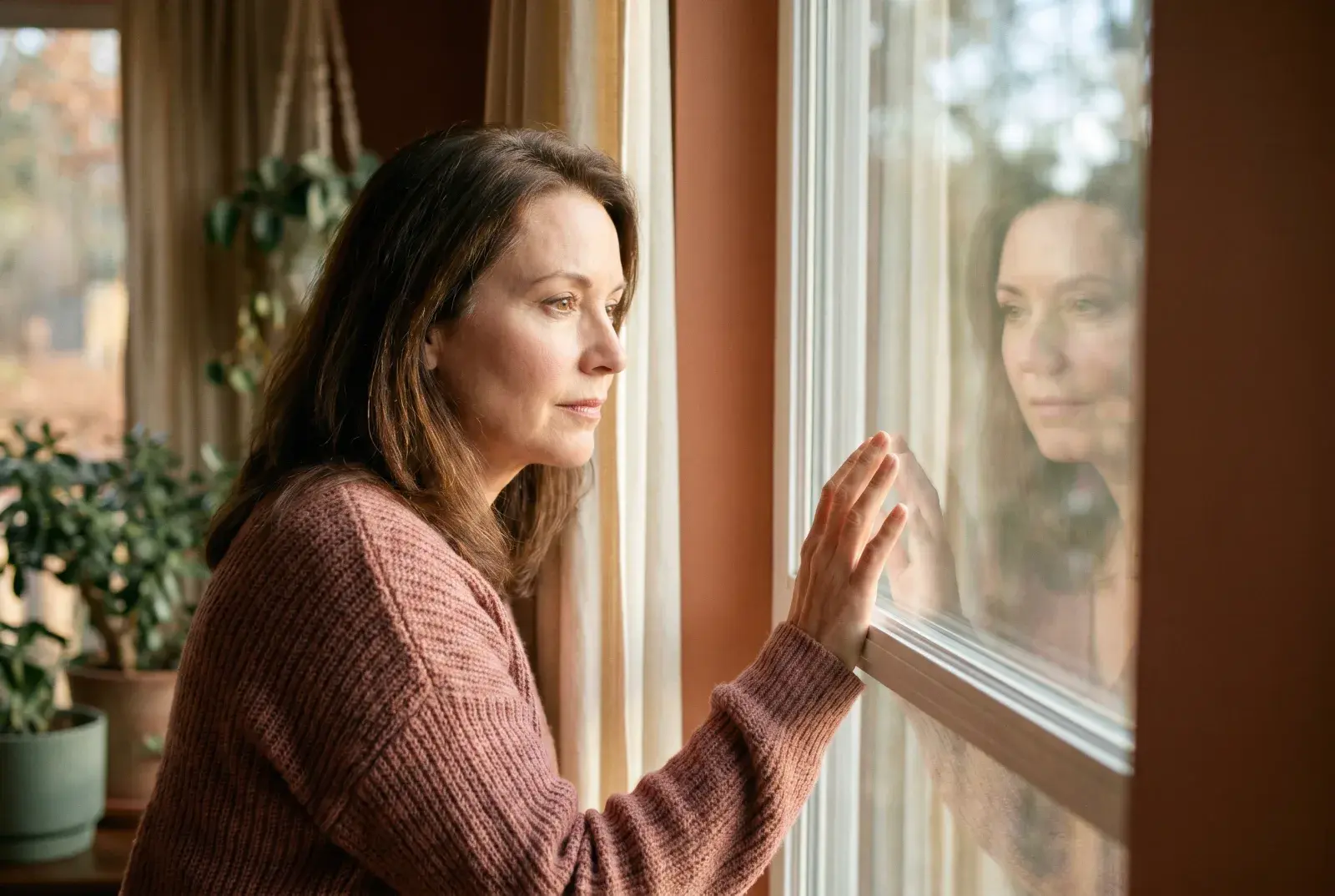
There is a particular kind of lost that does not look like anything is wrong.
From the outside, your life works. The bills are paid, the children are launched or launching, you have built something real. And yet, in the quiet moments, you catch yourself thinking a sentence that startles you: I built a beautiful life I do not recognize myself in.
If you are a woman in midlife and you have spent decades pouring yourself into other people, this feeling is not a sign that you have failed. It is a sign that you are ready. Learning how to find yourself again is not about throwing your life away and starting over. It is about coming home to the woman who has been waiting underneath all that giving. Here is how to begin.
Why you feel lost (and why it is not just a midlife crisis)
The phrase "midlife crisis" gets thrown around as though wanting more from your life is a malfunction. It is not. What you are experiencing is far more accurate to call a midlife identity shift, and it is one of the most natural things in the world.
For years, your identity had a job. You were someone's mother, someone's partner, the one who held it all together. Those roles are real and they matter, but they are not the same as your self. When the roles change, as they always eventually do, the self you set aside starts to make itself known again. The restlessness, the boredom, the quiet ache, even the tears that come out of nowhere, are not symptoms of something breaking. They are the sound of something waking up.
You are not having a crisis. You are having a calling.
You did not lose yourself. You outgrew an old version.
This is the reframe that changes everything for the women I work with. You did not misplace yourself somewhere in the school runs and the laundry and the years of putting yourself last. The woman you are looking for is not gone. She is simply no longer the version she was at 25, and that is exactly as it should be.
So much advice about finding yourself assumes you need to dig up an old self and dust her off. That is not it. The work is not to go backward. It is to gather everything you have become, the wisdom and the depth and the hard-won knowing, and let a truer version of you step forward. You are not reverting. You are arriving.
How to find yourself again: a gentle path back
Finding yourself again is less a project to manage and more a relationship to rebuild. These are the steps I walk women through, and you can begin them today, quietly, without announcing anything to anyone.
- Get quiet enough to hear yourself. You cannot find yourself in noise. Even ten minutes a day of stillness, with your phone in another room, begins to clear the static so your own voice can surface. Slow breathing, with a longer exhale than inhale, helps your nervous system settle enough to listen.
- Separate what is yours from what you inherited. Make two lists. On one, the beliefs, routines, and expectations that genuinely feel like you. On the other, the ones you absorbed from your family, your role, or the culture around you. You are allowed to set down anything on the second list that you never actually chose.
- Follow the spark, not the plan. You do not need a five-year vision. You need to notice what makes you lean in, even slightly. A book, a place, a conversation, a craft you abandoned years ago. Curiosity is the thread that leads you back. Pull on it gently.
- Run small experiments. Identity is not found by thinking. It is found by doing. Try the class. Take the trip. Say the honest thing. Each small experiment gives you real information about who you are becoming, which no amount of overthinking can provide.
- Tend your body as an ally. After years of stress and self-neglect, many women are living almost entirely in their heads. Returning to your body, through breath, movement, rest, and genuine pleasure that has nothing to do with anyone else, is one of the fastest ways to feel like yourself again.
- Be witnessed by women who get it. There is something that happens when you say the quiet thing out loud to women walking the same passage. They reflect you back to yourself. Isolation keeps you stuck. Being witnessed helps you remember who you are.
- Give it structure. A longing without a container tends to stay a longing. When you are ready to move from wondering to actually changing, a real framework and a steady rhythm turn the wish into a life.
Rediscovering yourself in midlife without burning your life down
Here is the fear that keeps so many women stuck. They believe that finding themselves again means blowing everything up. Quitting the marriage, leaving the job, becoming unrecognizable.
It almost never does. Rediscovering yourself in midlife is usually far quieter and far more sustainable than the dramatic stories suggest. It looks like reclaiming small pieces of your day, speaking more honestly in your relationships, and slowly shifting the center of gravity in your life back toward yourself. The changes that last are rarely explosions. They are a thousand small acts of returning. You can become radically more yourself without setting fire to the life you have built. In fact, the most beautiful version of this often makes the life you have built warmer, because you are finally in it as a whole person.
Reinventing yourself at 50 and beyond
The word "reinvention" can feel exhausting, as though you are being asked to become a brand-new person on top of everything you already carry. So let me offer a softer truth. Reinventing yourself at 50 is not about invention at all. It is about return.
You are not building a stranger. You are remembering a self that has been there the whole time, and giving her room to lead. This is the great, mostly unspoken gift of this stage of life. You have the self-knowledge you lacked at 25 and the freedom you lacked at 35. Whatever the culture says about a woman's relevance fading in midlife, the opposite is true. This can be the chapter where you become the most fully, unapologetically yourself you have ever been.
What finding yourself actually feels like
You will know it is happening not by some dramatic transformation, but by a quiet shift. Things start to feel more like yours. You make a choice and it lands cleanly, without that old static of guilt or second-guessing. Your energy comes back. You feel, for the first time in a long time, like the author of your own days rather than a supporting character in everyone else's.
In the work I teach, this is the Frequency Anchor restored. For years you were anchored to everyone else's needs. Finding yourself again is the steady, grounding process of becoming anchored to your own center, so that the love and care you give from here flows out of fullness instead of depletion. That is not selfish. It is the most generous thing you can do, because everyone in your life now gets the real you.
You are not here to disappear into the second half of your life. You are here to finally inhabit it.
Frequently asked questions
Why do I feel so lost in midlife?
Because the roles that organized your identity for years, especially motherhood, are changing, and the self you set aside to serve them is ready to re-emerge. The restlessness and sadness are not signs of failure. They are signs that you are ready for a truer chapter.
Is feeling lost a midlife crisis?
It is more accurate to call it a midlife identity shift than a crisis. Wanting more meaning and connection with yourself is a natural developmental stage, not a malfunction. Handled with care, it becomes an opening rather than a breakdown.
How do I start finding myself again?
Begin with stillness so you can hear yourself, separate what is genuinely yours from what you inherited, follow small sparks of curiosity, run low-stakes experiments, reconnect with your body, and surround yourself with women walking the same path. Small, consistent acts of returning matter more than any dramatic change.
Is it too late to reinvent myself at 50?
No. Reinvention in midlife is really a return to a self that has been there all along, now paired with decades of wisdom and a new freedom. For many women, this becomes the most authentic and alive chapter of their lives.
Will finding myself again disrupt my marriage and family?
Usually not in the way people fear. The healthiest version is quiet and sustainable: reclaiming small pieces of your day and speaking more honestly. Many women find that becoming more themselves actually deepens their closest relationships, because their loved ones finally get the whole person.
You do not have to find your way back alone
If you are tired of feeling like a stranger in your own life, there is a gentler, more grounded way forward.
- Download The Clarity Guide, my free first step for women ready to come home to themselves.
- Join The Oasis, a free private community of women rediscovering who they are after years of putting everyone else first.
- When you want a real path with structure and support, The Divine Plan for a Life You Love walks you through five elemental pillars: Reimagine, Renew, Reignite, Receive, and Recalibrate.
- Or book a free discovery call and tell me where you are. There is no pitch, just a real conversation.
Related reading: Empty Nest Syndrome: You Were Never the Problem.
Jenny Warner is a Certified Life Coach, breathwork facilitator, and EFT practitioner who works with women 45 to 60 navigating the empty nest and the midlife identity shift. Her approach integrates HeartMath research on heart coherence, somatic practice, and the divine-feminine lineage into a grounded path she calls the Frequency Anchor.